Paris MatchPierrick Geais · 21 October 2026
“When my father died, she became my burden”: Daphné Rotcajg’s bittersweet memories of Régine, her grandmother
Daphné Rotcajg, Régine’s only granddaughter, is publishing a book about her dysfunctional family. In this exclusive, she talks about the grandmother she loved as much as she loathed.
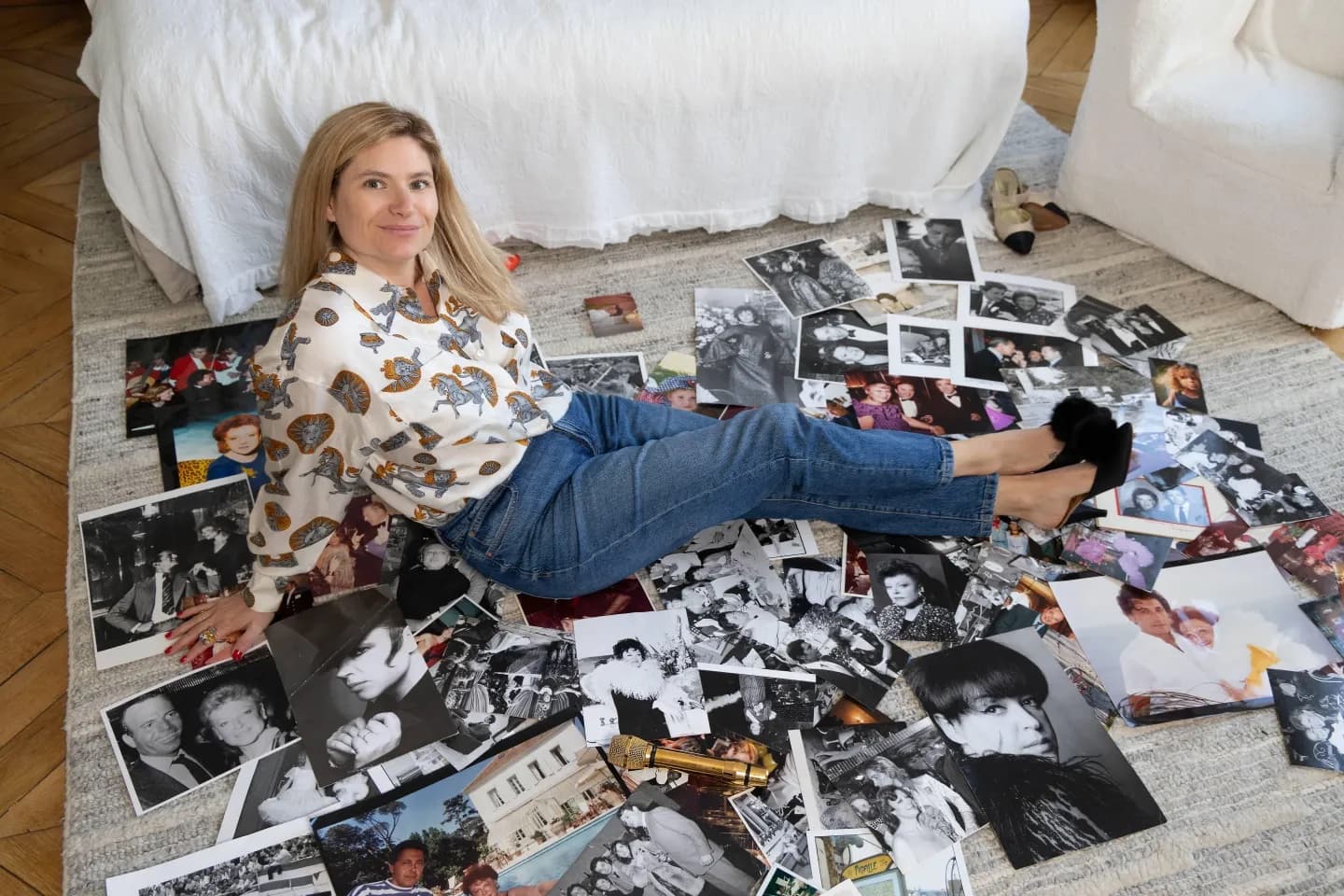
Her surgeon had told her to stay home for at least a week. But a small facelift — far from her first — wasn’t going to stop Régine in her perpetual social marathon. Three days after the operation, there she was at a grand dinner, laughing her head off, unaware that the sutures behind her ears had split and her face had begun to sag. She would eventually have to slip out through a back door.
To tell this colourful anecdote, Daphné Rotcajg leaps off her sofa, imitates her, performs her, brings her back to life…
You understand why Régine dreamed of seeing her granddaughter play her in a musical she had imagined, “Les Lumières de Belleville”, which never made it to the stage. The “Queen of the Night” — who had several hits to her name, some written by Gainsbourg — was convinced Daphné had every bit the makings of a singer. Even if Daphné admits she’d love to enter Eurovision, she never seriously considered music as a career. After various other paths, she is today a writer and keeper of Régine’s memory. Her first book is dedicated to her, though it isn’t strictly a biography.
The idea was suggested by her maternal grandfather, John Boorman, the director of Deliverance, who revelled in the stories she told him almost every day about “that pain in the arse” — or more precisely, “her pain in the arse.” Like the time Daphné, then living in London, invited her grandmother for the weekend and put her up in a magnificent five-star hotel in Knightsbridge. Not chic enough for Régine, who demanded her Louis Vuitton trunks be moved to the most expensive hotel in the city — and Daphné eventually gave in.
“I know her demands better than anyone. Her whims. The way she enters a room as though she’s just discovered a world unworthy of her. She hates cheap fabrics, harsh lighting… She cannot bear to wait. Not tea too hot, not tea too lukewarm,” writes Daphné. The writing is tender but hides nothing of Régine’s many flaws: narcissistic, egocentric, possessive, difficult… She is the archetype of the ultimate diva, the kind you usually only see in films. “She saw herself as an icon, as the most important person on the planet. She was convinced she’d launched everyone’s career. Even Tom Cruise’s, for example — someone she’d never actually met,” says Daphné.
Régine always had a creative relationship with the truth — not for the pleasure of lying, but to embellish reality. So when she found herself sitting next to Daniel Craig at a party, she told everyone the next day that “James Bond had fallen madly in love with her and had been bombarding her with sweet nothings ever since.” “She wrote five autobiographies, with the same stories all five times, but always in different versions,” Daphné notes.
Wounds passed down
If she never took drugs, smoked or drank, Régine held back on no other excesses. Certainly to forget the poverty of her childhood, she spent fortunes on Chanel shoes and Zadig & Voltaire jumpers in every colour. And on caviar and champagne, which she kept in her fridge in case friends dropped by unannounced. Surrounded by people who loved her, Régine nonetheless felt a deep loneliness. “You are my only family,” she would often tell Daphné, her only granddaughter, whom she could call up to twenty times a day — simply to moan.
“When my father died — her son — she became my burden, and I was only eighteen.” Their relationship swung between bursts of laughter, complicity, undigested resentments and rows. Daphné cut off all contact with Régine for almost a year after she published a book about her father, À toi, Lionel, mon fils (Flammarion, 2010): “I found it unbearable. She painted herself as a heroic mother when she had been absent for him. I asked her to remove a passage about the death of my father’s first son; she promised she would but didn’t.”
Daphné’s book is the story of a dysfunctional clan in which trauma and wounds are passed down from generation to generation. Starting with Régine herself: convinced throughout her childhood that her mother had abandoned her to return to Argentina, she discovered decades later that her father had actually lost the tickets meant to bring them together in a game of poker. Rather than breaking the cycle, she could have been a loving maternal figure — but, too caught up in her affairs, she sent her son Lionel to a nanny until he was six and then to boarding school. When he came back to live with her at fourteen, he was unpleasantly surprised to find that his “bedroom” was a camp bed in her dressing room.
In his turn, he would be a poor father to Daphné. Her mother, Telsche Boorman, had died of cancer when Daphné was just seven, so he was left to fill both roles — yet he was ultimately unpredictable and violent. With tears in her eyes, Daphné says: “I think he had an illness, but back then nobody talked about mental health. His violence was directed at himself before it was directed at me. So today I feel no anger towards him.”
A hearse drawn by two plumed stallions
When Daphné built her own family — with her English husband and their two sons, Leo and Phoenix — she vowed not to repeat the mistakes of the past. She also had to watch over Régine, as a mother would, when she was found unconscious at home, suffering from hyponatraemia, then transferred to hospital and placed in a coma. When she came round, Régine was convinced — for almost twenty-four hours — that she was a mad scientist who had found a formula to save humanity. “Even when she wasn’t herself, she stayed megalomaniacal,” Daphné laughs.
Later, Régine was placed in the Maison des Artistes care home, where she spent her final months. Even her funeral was a headache for Daphné, who had to accommodate the star’s last whims: her coffin was transported on a horse-drawn carriage pulled by two stallions decorated with feathers.
That same evening, Daphné was torn between relief and guilt: “I regretted having let her invasive side overshadow her incredibly fun side. I had the feeling I’d spent so much time complaining about her that I couldn’t say I was sad. It broke my heart not to be able to say out loud that yes, actually, I already missed the old cow.”
A frankness Régine would have been proud of. From her grandmother, Daphné inherited no great fortune — “she’d been ruined since the 1990s. Everything had been sold during her lifetime. Former benefactors were paying for her care home” — but she did inherit her streetwise charm. “Most of all I hope I have her determination, her zest for life, and the way she always saw the glass as half full.” To forget the bad memories and keep only the best.
“À tout de suite”, by Daphné Rotcajg. Éditions Grasset, 224 pages, €20.
Translated from the French and published with the permission of Paris Match. Read the original on Paris Match (in French).